Skip to content
Site navigation Search

Ran GTPase Peptide Inhibitor for Chemo-resistant Breast Cancer

Background and Opportunity

Annually 2.26m women are diagnosed with Breast Cancer (BC) globally and 685,000 deaths annually, 90% of deaths arise from metastasis (the spread of cancer) and recurrence. Triple Negative Breast Cancer (10-20% of all BC cases) is associated with elevated risk of metastasis. Chemotherapy is used to treat HER-2, TNBC, larger tumours & metastasis. Paclitaxel and Doxorubicin are commonly used chemo-treatments for BC. This opportunity from the University of Bradford is underpinned by a patent family which is focussed on the inhibition of Ran GTPase as a therapy for cancer treatment with a focus on a new treatment to combat chemotherapeutic resistance in triple negative and metastatic breast cancer.

The Problem

Chemotherapy is one of the standard therapies for breast cancer (BC), but the resistance of BC cells to chemotherapy drugs is a huge challenge for its effective treatment. Chemoresistance is a main cause of BC-related death, as it results in recurrence and metastasis. Thus, overcoming this issue is critical to improving the prognosis of patients with BC. The response rate of metastatic BC to first-line chemotherapy drugs is usually 30%–70%, but it is not persistent, drug resistance occurs in 6–10 months, resulting in treatment failure.

The 5-year survival rate of patients with metastatic breast cancer is only 27%. Triple Negative Breast Cancer (TNBC) represents approximately 15-20% of all newly diagnosed BCs and is generally a more aggressive disease with a poorer prognosis and higher grade than other types of BC, accounting for 5% of all cancer- related deaths annually. TNBC is the most lethal subtype of BC owing to high heterogeneity, aggressive nature, and lack of treatment options. Chemotherapy remains the standard of care for TNBC treatment, but unfortunately, patients frequently develop resistance. The median overall survival (OS) for the disease is 10.2 months with current therapies, with a 5-year survival rate of ~65% for regional tumours and 11% for those that have spread to distant organs. The major obstacle in successfully treating TNBC is resistance to cytotoxic chemotherapy, the mainstay of treatment in this disease.


Application

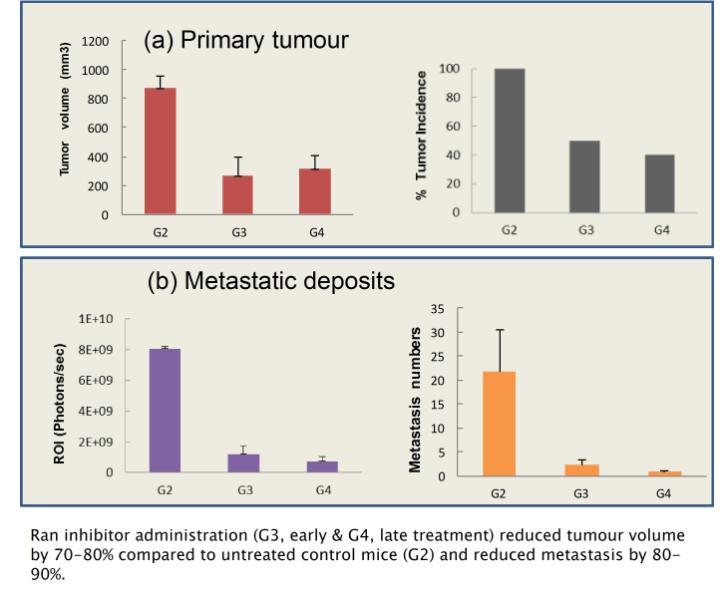
Ran GTPase is highly expressed in many solid cancers, high levels are associated with poor patient prognosis/metastasis. UoB has developed a peptide inhibitor of Ran (Ran IP) that reduces levels of Ran GTPase in cancer cells but not in normal cells (Ref 1). The peptide interacts with RRC1 and blocks the coupling with Ran GDPase so preventing formation of Ran GTPase. UoB has developed a formulation in which Ran IP is encapsulated in a liposome and have proven in vitro & in-vivo efficacy2. Ran IP reverses increases in Ran levels with administration of chemotherapies in breast cancer models2, also observed in lung cancer cell lines. Further in-vivo studies2 demonstrated that co-administering Ran IP with chemotherapy causes the tumour to almost disappear (breast cancer model) with no significant increase in toxicity (Ref 2)

Benefits

The in vivo results confirmed the enhanced anti-cancer activity of double-loaded liposome by achieving 85.91%, 95.55%, and 97.77% tumor growth inhibition after treatment with different doses of 1X, 2X and 3X of the double-loaded liposome. Toxicity examinations showed that a combined-drug delivery system was found to be safer to liver and kidney tissues when compared to the free DOX. The emergence of a novel drug delivery system is of high clinical importance because it will improve the therapeutic response by providing a synergistic anti-tumor effect both in vitro and in vivo along with causing minimal side effects compared to classic dosage forms of the same drugs.

IP Status and investment opportunity

Patent Status: Priority date (UK) 29 April 2016

Patent filings in Europe, Granted in China, India & US 2024

Patent fully owned by UoB

Investor/collaborator required to take lead through preclinical testing to preIND submission. Potential UoB spin-out opportunity, with significant interest from UK investment fund.

Carmen Diagnostic Technologies Ltd are developing a companion diagnostic for detection of Ran levels in breast cancer.

References

1. Yuen HF, Chan KK, Platt-Higgins A,, El-Tanani M. et al, Ran GTPase promotes cancer progression via Met receptor-mediated downstream signaling. Oncotarget. 2016 Nov 15;7(46):75854-75864. doi: 10.18632/oncotarget.12420. PMID: 27716616; PMCID: PMC5342783.

2. Co-delivery of a RanGTP inhibitory peptide and doxorubicin using dual-loaded liposomal carriers to combat chemotherapeutic resistance in breast cancer cells. Y. Haggag,M. El-Tanani et al; Expert Opin Drug Deliv. 2020 Nov;17(11):1655-1669 doi: 10.1080/17425247.2020.1813714.