Skip to content
Dr. E.G. (Ted) Edwards, the first Vice-Chancellor of the University of Bradford, holding up a copy of the University Charter in 1966.

Our foundations

In 1961, Harold Wilson published a report recommending that higher education should be ‘available to all those who are qualified for it by ability or attainment and who, by reason of their limited means, would not otherwise be able to go to university’. Based on this report, in 1966 the University of Bradford was established.

"Over the last six decades, this University has built on this proud legacy. We have been champions of a transformative education which produces excellent employment outcomes, pioneers in research and innovation, and a University of and for Bradford. I think Harold Wilson would be proud."

Professor Nick Braisby, Interim Vice-Chancellor

Events

Two graduates in their gowns and headwear look up with an arch of balloons behind them

From establishing the first School of Peace Studies, founding one of the oldest business schools in the country and creating the Bradford Burns Unit.

And we are still making a difference today. 

We are ranked 1st in the country for impact on social mobility, 8th nationally for boosting students' academic outcomes, 16th nationally for graduates entering high-skilled employment and 77% of our research impact is rated excellent or world leading.

These achievements are the result of the vision and dedication of our staff, students, alumni and everyone who works in partnership with us.

Share your story

Whether it is a story from when you studied at the University, an event you attended or a project you worked on that made a difference, we want you to share it with us. Your stories may become part of other activities throughout our 60th Anniversary.

1960s (5)

1966

  • University of Bradford is born 
  • Prime Minister Harold Wilson becomes Chancellor
  • We established the UK's first pharmacy practice research unit

1967

1969

  • Tony Benn, Minister of Technology, opens the new Chemical Engineering Building

1970s (7)

1970

  • Twin probe instrument invented to help uncover the buried past

1971

  • Pink Floyd plays the University

1972

  • Employed our first female professor, a Professor in Sociology

1973

  • The School of Peace Studies is founded

1974

  • Launched the world's first academic qualification in archaeological science, with the MA in Scientific Methods in Archaeology.

1975

1979

  • Our team were victorious in University Challenge in January 1979

1980s (5)

1980

1985

1986

  • Sir John Harvey-Jones becomes Bradford’s second Chancellor

1988

  • Academic Thomas Geoffrey Booth (known as Geoff) became the UK's first Professor of Pharmacy Practice

1989

  • Polymer Interdisciplinary Research Centre is formed

1990s (7)

1991

  • Nirvana plays the communal building

1992

  • Sir Trevor Holdsworth is appointed as our third Chancellor

1994

1995

  • We founded Bradford Particle Design (BPD), which later went on to develop ground-breaking crystallisation technology and sold for $200 million six years after it was created. 

1996

  • We joined with the former Bradford and Airedale College of Health, which later became the School of Health Studies.

1997 

  • Baroness Betty Lockwood becomes our fourth Chancellor

1999

  • Rock band Terrorvision played the Communal Hall (now Student Central)

2000s (6)

2004

  • We launched courses in Law and Human Resource Management

2005

  • Imran Khan becomes our fifth Chancellor
  • An £84m project to redevelop campus was announced which included a focus on improving our sustainability 

2006

2008

2010

  • We developed a new material to make filling root canal's easier and reducing the five-year failure rate


2010s (5)

2013

  • European Space Agency collaborate on space weather
  • Uncovered hidden secrets of Stonehenge

2015

  • Queen’s Anniversary Prize for world-leading Dementia research

2016

  • Public generosity to the Crocus appeal supports cancer breakthroughs
  • Kate Swann is appointed as our sixth Chancellor

2020s (8)

2022

2023

  • AI set to revolutionise the organ donation process

2024

2025

Our Anniversaries

During this year we are also proud to be marking other significant milestones across the institution, including:

Theatre in the Mill - Celebrating 50 years

JB Priestley Library- Celebrating 50 years

Healthcare Leadership - Celebrating 30 years

Biomedical Engineering - Celebrating 30 years

Clinical Technology - Celebrating 25 years

Centre for Inclusion and Diversity - Celebrating 20 years

Behind the Walls

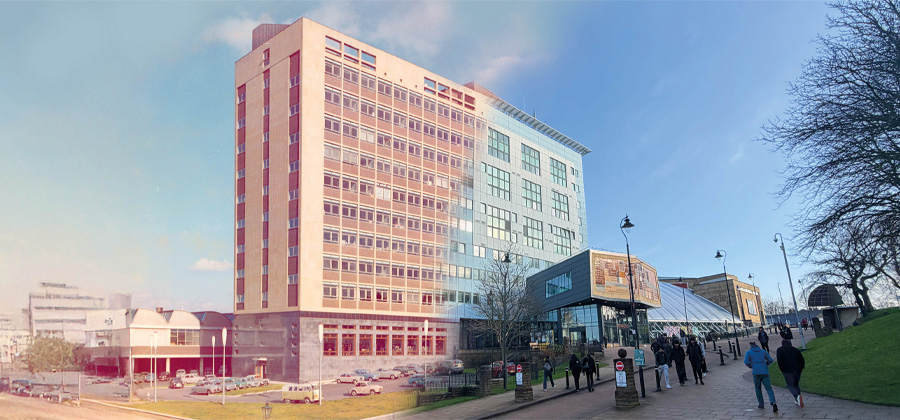
Over the last 60 years our campus has transformed, shaping the experiences of our staff and students. Behind these walls, ideas take shape, breakthroughs happen, and careers are started. Explore how our campus has changed and discover examples of how our research, innovation and achievements have been making a difference since 1966.

News

Nostalgia image back issue of Student News magazine

Sixty Years in the Making: A Journey Through Our University Archives

April 2025

To mark our 60th anniversary, we’ve opened the University’s archive of staff and student newsletters to trace how campus life, culture and community have evolved from the 1960s to the 2010s.

A black and white photo from the 1970s of people standing up in a group shot

'Peace Studies problem' starts 60th anniversary lectures

March 2025

A remark reportedly made by Margaret Thatcher; ‘Has that Peace Studies problem been dealt with yet?’ is now inspiring a forward-looking conversation as the University launches its 60th anniversary lecture series.

A young child wearing a university branded T-shirt waves a flag on a football pitch

Celebrating 60 years at Bradford City AFC takeover

February 2026

Bradford City AFC received extra support from University staff and students as we took over one of the club’s home matches.

60th anniversary cake

University launches 60th anniversary year celebrations

December 2025

The University officially kicked off its 60th anniversary year celebrations, with a commitment to preserve the legacy of City of Culture.